
Four-and-a-half billion years ago, Earth’s surface was a menacing, hot mess. Long before the emergence of life, temperatures were scorching, and the air was toxic. Plus, as a mere toddler, the Sun bombarded our planet with violent outbursts of radiation called flares and coronal mass ejections. Streams of charged particles called the solar wind threatened our atmosphere. Our planet was, in short, uninhabitable.
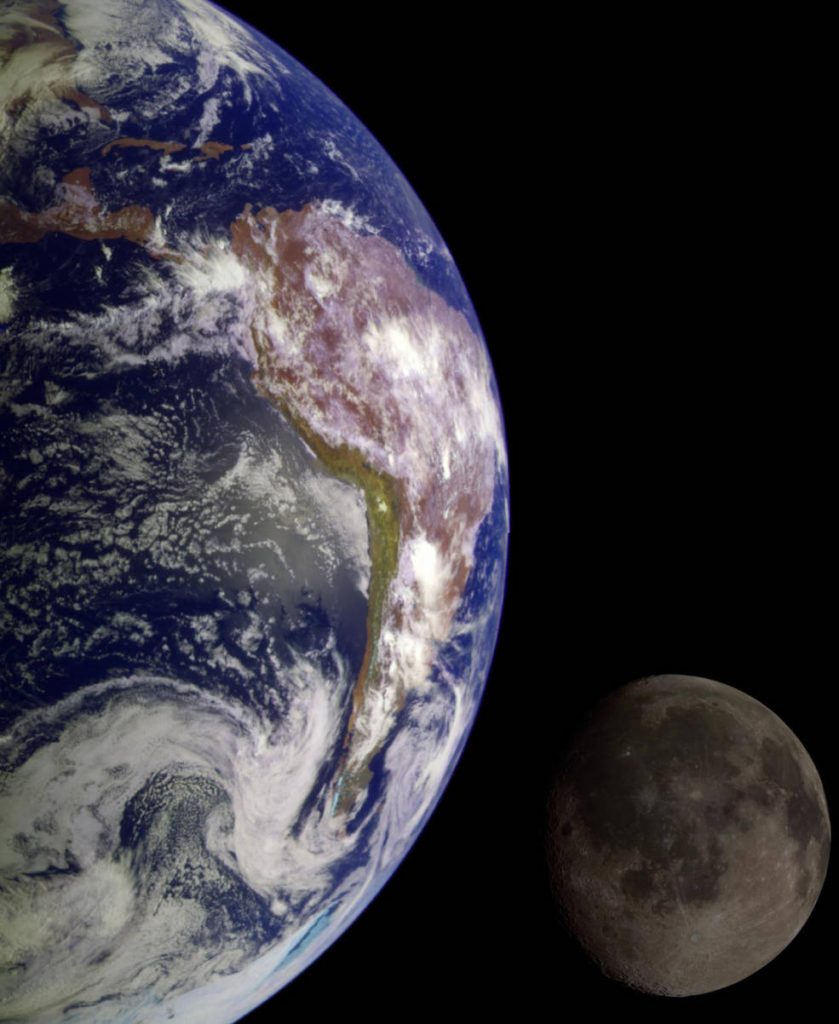

The Earth and Moon, shown here in a composite of two images from the Galileo mission of the 1990s, have a long shared history. Billions of years ago, they had connected magnetic fields.
Credits: NASA/JPL/USGS
but a neighbouring shield may have helped our planet retain its atmosphere and eventually go on to develop life and habitable conditions. That shield was the Moon, says a NASA-led study in the journal Science Advances.
A Brief History Of the Moon
the Moon formed 4.5 billion years ago when a mars-sized object called Theia slammed into the Proto-Earth when our planet was less than 100 million years old, according to leading theories. Debris from the collision coalesced into the moon, while other remnants reincorporated themselves into the earth. Because of gravity, the presence of the Moon stabilized the Earth’s spin axis. At that time, our planet was spinning much faster, with one day lasting only 5 hours.
The new study simulates how the magnetic fields of the Earth and Moon behaved about 4 billion years ago. Scientists created a computer model to look at the behavior of the magnetic fields at two positions in their respective orbits. at certain times, the Moon’s magnetosphere would have served as a barrier to the harsh solar radiation raining down on the Earth-Moon system! That’s because, according to the model, the magnetospheres of the Moon and Earth would have been magnetically connected in the polar regions of each object! that is rally cool!

Credits: NASA
Recent Comments