
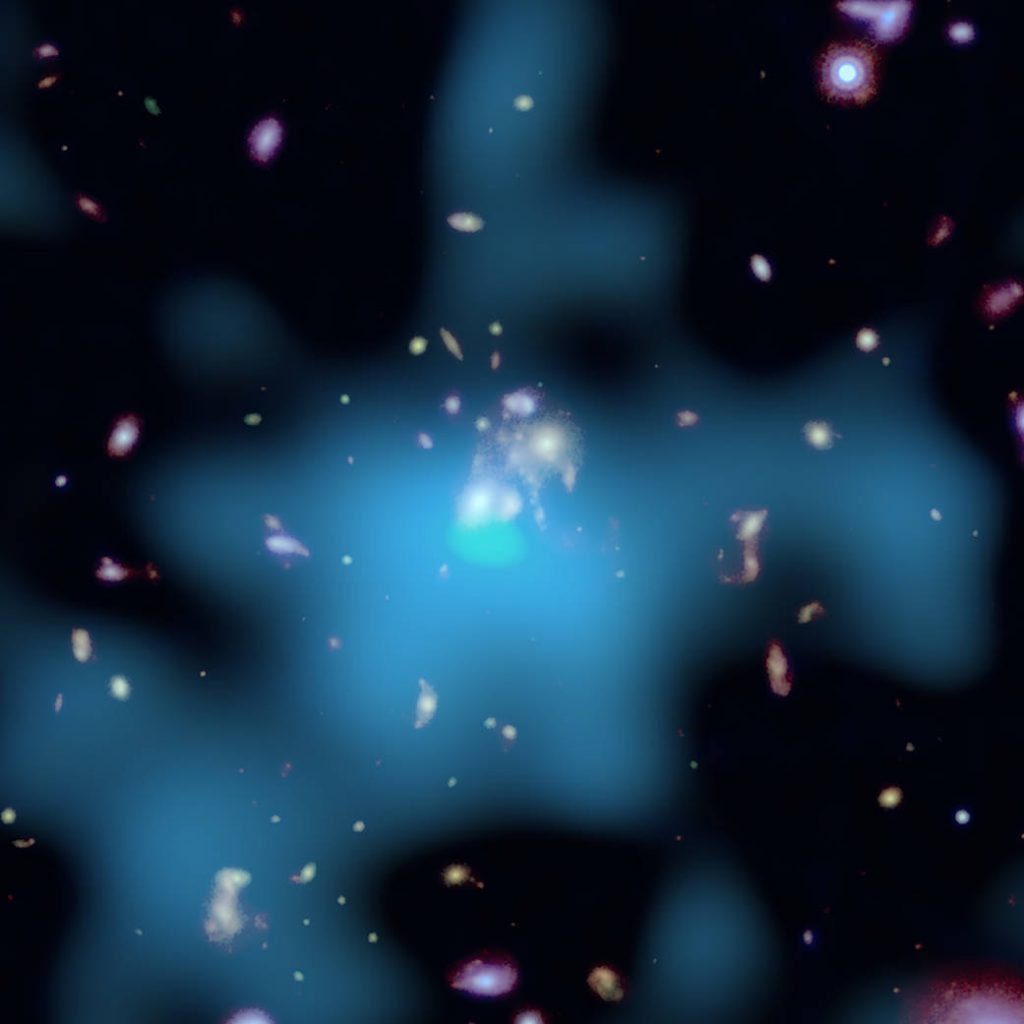
Astronomers have discovered what can happen when a giant black hole does not intervene in the life of a galaxy cluster. using NASA’s Chandra X-ray Observatory and other telescopes they have shown that passive black hole behavior may explain a remarkable “torrent” of star formation occurring in a distant cluster of galaxies. galaxy clusters contain hundreds or thousands of galaxies pervaded by hot, X-ray emitting gas that outweighs the combined mass of all the galaxies. Ejections of material powered by a supermassive black hole in the cluster’s central galaxy usually prevent this hot gas from cooling to form vast numbers of stars. This heating allows supermassive black holes to influence or control the activity and evolution of their host cluster. But what happens if that black hole stops being active? the galaxy cluster SpARCS104922.6+564032.5 (SpARCS1049 for short) located 9.9 billion light years away from Earth is supplying one answer! based on observations from NASA’s Hubble Space Telescope, astronomers had previously discovered stars were forming at an extraordinary rate of about 900 new Suns worth of mass per year in SpARCS1049! About 2.47 stars a day!!!! this is over 300 times faster than the rate at which our galaxy, the Milky Way, is forming its stars! Very, Very cool.
Recent Comments